


The Second-Home Wardrobe: How UHNI Families Compose Style Across Alibaug, Mussoorie, Goa, Dubai, and Beyond
It is a Friday evening, 5:00 PM. The car is idling below the BKC tower. The bag is packed for Alibaug. Somewhere between the ferry and the guest arrivals at eight, our client realises the ivory linen kurta he needs for tomorrow's brunch is hanging in his Worli walk-in.
For families who move between city apartments, weekend homes in Alibaug or Kasauli, extended stays in Goa, a flat in London, and a business address in Dubai, this is not an isolated mistake. It is a structural gap. The wardrobe was built for one location. The life is lived across six.
We meet this often. A promoter with residences in South Bombay, Alibaug, and Dubai. A family whose children study in Mussoorie while parents host summers at their Coorg estate. A steel dynasty with a Kolkata bungalow, a Delhi apartment for board meetings, and a Rajasthan haveli for winters. Each home works. Each wardrobe underperforms. And every departure carries a small, quiet cost: the outfit that had to be couriered, the shirt bought in-country at markup, the photograph that captures the wrong shade of ivory.
Why single-city wardrobes fail multi-residence lives
A wardrobe is not just clothing; it is an operating system. Move the operator across geographies and the operating system fractures. Four failures recur.
The wrong climate arrives first. Alibaug is coastal and briny. Kasauli sits at nineteen hundred metres. London is damp for eight months. Dubai runs at forty-two degrees for five. Clothing chosen for Mumbai's air-conditioned interiors does not translate; it warps, wilts, or embarrasses.
Occasions are location-specific. An Alibaug brunch is a linen affair with kolhapuris. A London Christmas dinner requires wool. A Diwali card party in Delhi calls for a bandhgala and pashmina shawl. When wardrobes are undifferentiated, dressing becomes a series of near-misses.
The logistics of movement are punitive. Excess baggage on private aviation is invisible. On commercial, it is friction that erodes ease. Couriering a specific outfit between Mumbai and Goa is a workaround, not a system.
Household staff need brief. If the London housekeeper does not know that the Loro Piana overcoat needs breathable canvas storage between wears, the coat suffers by June.
Composing a residence-aware wardrobe
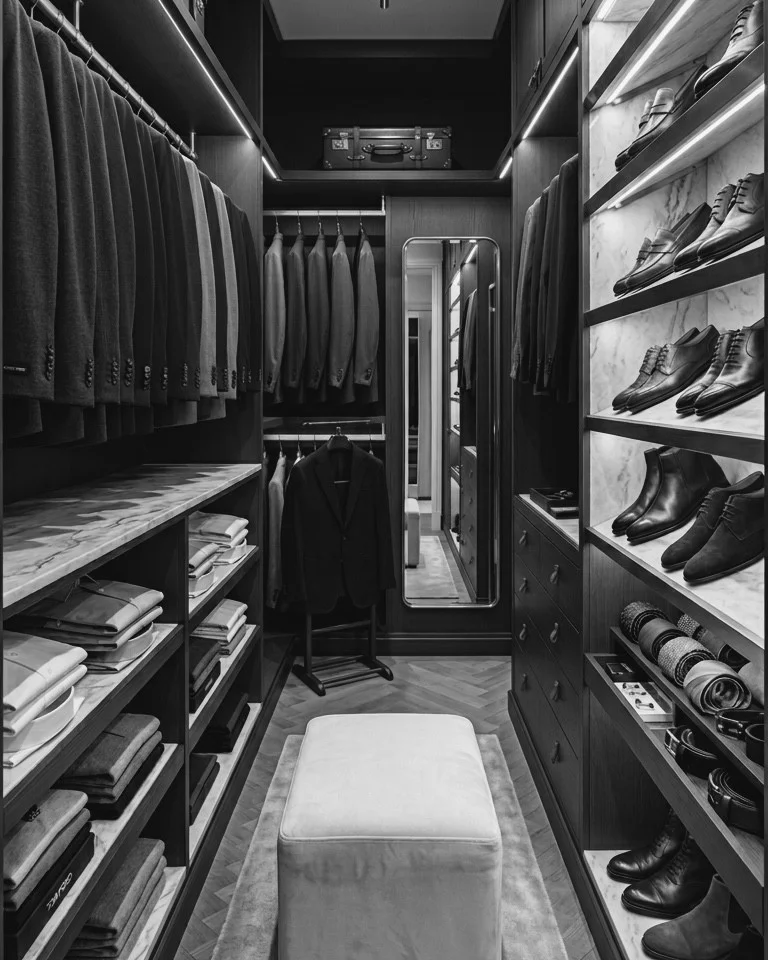
We build wardrobes as systems, not silos. For multi-residence clients, the architecture begins with a single organising principle: the primary wardrobe lives at the primary residence, and every other home holds a purpose-built extension of it. Not a duplicate. A calibrated echo.
The Alibaug wardrobe, for a Mumbai client, is a hosting capsule. Ivory linen kurtas by 11.11 or Anavila, breathable cotton shirts, tailored shorts, a linen suit for the wedding on the sand, dhoti pants for the evening, kolhapuris and one pair of soft driving loafers. Nothing that will crumple in humidity. Nothing that cannot dry overnight.
The Goa second home extends this coastal ease with a longer evening rotation, because stays are deeper. A silk shirt, one unstructured wool-linen dinner jacket, loafers that survive sand, a raw-silk kurta for the Susegado dinner.
Hill homes in Kasauli, Mussoorie, or Lonavala are entirely different. Cashmere sweaters, tweeds by Ermenegildo Zegna or a well-chosen local mill, trench coats, brogues, walking boots, one bandhgala for the temple visit. The wardrobe reads winter even in April.
The London flat is a business-personal hybrid. Heritage tailoring lives here permanently, in weights that suit British weather. Two Turnbull and Asser shirts, a broken-in pair of Church's Oxfords, a navy overcoat, a dinner suit that never travels because it is always needed. The Indian occasion wear for the Somerset weekend wedding arrives on the client, not from Mumbai.
The Dubai apartment is where boardroom meets resort, often within the same day. Lightweight wool suits for the DIFC morning, a kaftan or bandhgala for the majlis evening, resort shirts for the Saturday yacht. Fabrics chosen for forty-plus degree heat, not Mumbai humidity.
The operational spine
Behind every residence-aware wardrobe sits an infrastructure. We build a master wardrobe index, a digital catalogue mapped by home, so any piece is locatable in seconds. Seasonal audits are staggered by residence: Alibaug in March before the season begins, hill homes in September before winter, London in October, Dubai year-round. Storage briefs are written for the housekeeper at each address, laminated where necessary. When the family moves, movement is planned; a single overnighter carries only what the destination genuinely lacks.
Restocking is quiet. When an Alibaug shirt has aged past its second summer, we replace it before the next visit, not during. When the London wardrobe needs a new dinner jacket for the Ascot season, it is delivered to the flat before the family arrives.
For families with private aviation, the system extends further; a permanent flight wardrobe lives on-board, pre-styled for arrival at primary destinations. For those without, we design a travel capsule that reduces packing to a single carry.
None of this looks like management from the outside. That is the point. What our clients experience is arrival: at Alibaug, at Kasauli, at the Mayfair address, at the DIFC apartment. Everything is present, pressed, and waiting.
The considered wardrobe is not a single closet. It is a family of closets in conversation, held by a single sensibility.
Composed with discretion. Held with intention. Preserved as legacy.
Frequently Asked Questions
What is a second-home wardrobe?
A second-home wardrobe is a purpose-built extension of a client's primary wardrobe, held at a secondary residence and calibrated to that home's climate, occasions, and lifestyle rather than duplicated from the main closet.
Do you manage wardrobes across cities in India?
Yes. We manage multi-residence wardrobes across Mumbai, Delhi, Gurugram, Bangalore, Hyderabad, Chennai, Kolkata, Indore, Bhopal, Udaipur, Surat, Ahmedabad, Jaipur, Alibaug, Goa, Kochi, hill retreats, and beyond, alongside international residences in London, Dubai, Singapore, and select European addresses.
How does an Alibaug wardrobe differ from a Mumbai wardrobe?
An Alibaug wardrobe prioritises breathable linen, coastal palettes, and hosting-ready pieces that survive humidity and salt air, while the Mumbai wardrobe accommodates air-conditioned interiors and a broader professional and formal rotation.
Can you set up a permanent wardrobe at our London or Dubai apartment?
Yes. We build residence-based wardrobes at international addresses, covering in-country sourcing, seasonal restocking, and staff briefing, so the client arrives to a curated closet at every residence.
How do you handle wardrobe logistics between residences?
Every piece is catalogued digitally and mapped to a home. Movement between residences is planned so travel carries only what is genuinely missing at the destination, reducing packing weight and courier dependence.
Do you train butlers or housekeepers at each residence?
Yes. We prepare care briefs for the household staff at each residence, covering storage, seasonal rotation, and material-specific handling, so wardrobes are preserved consistently regardless of location.
Is this service only for families with multiple homes?
Multi-residence wardrobe management is typically taken up by families with two or more homes and frequent movement between them. Even a single second home benefits from a distinct, purpose-built wardrobe rather than repeated packing.
How often are second-home wardrobes refreshed?
Refresh cadence is guided by season and use. Coastal and hill wardrobes are audited before their active season; business residences are reviewed twice a year; occasion pieces are updated as calendars require.
A private view into new launches, trusted brands, and what’s next.