


The Wardrobe Was Never a Household Job
Why a considered collection needs an atelier, not a maid.
There is a specific quiet in an HNI home on the morning of a wedding function; the mother of the bride dressed and waiting, the driver idling in the porch, and the housekeeper at the cupboard with a Kanjeevaram in her hands and a slow expression forming on her face. Damp along one edge. A faint bloom of mildew. Six months in that cupboard, and nobody noticed. Nobody was meant to notice. She was never asked to know.
This is the moment, replayed in a hundred variations, that brings families to The Luxe Wardrobe. The Louis Vuitton wallet polished by the household with the wrong cream, its patina dulled beyond recovery. The Louboutins sent by driver to a local cobbler with no brief, returned with the sole guard on wrong. The uncut polki set stored beside costume pieces through a Mumbai June, corroding at the settings by August. These are not the failures of careless staff. They are the failures of a wardrobe left in the wrong hands entirely; because a wardrobe of this order was never a household job to begin with.
The illusion every family carries
Every family we meet holds the same quiet assumption; that the maid who has been with the family for twelve years will somehow know how to look after the Sabyasachi. That the driver will know which of Mumbai's dry-cleaners can be trusted with a vintage Chanel. That the housekeeper who oversees the linens will, by extension, oversee the jewellery, the leathers, the archival textiles, the couture. This is an illusion, and an expensive one. It has nothing to do with loyalty or years of service. It has everything to do with expertise, the same reason no considered family would ask its cook to conserve a Souza or its driver to service a Patek. Wardrobe management is a diagnostic profession. It requires reading condition, vendor networks, storage architecture, atelier coordination. None of it sits inside a domestic job description. All of it is what a wardrobe atelier is built to hold.
What we actually do
When The Luxe Wardrobe takes on a client's wardrobe, the household is relieved of the impossible burden of pretending to manage it. Our team runs the wardrobe end-to-end. Twice a year we conduct the seasonal rotation on-site - a full day, sometimes two - moving out-of-season pieces into archival storage, setting the working wardrobe for the season ahead, updating the digital catalogue in real time. In April, heavy embroidery, wool, and cashmere move out; linens, cottons, and silk chiffons come forward. In September, the reverse. Through the monsoon, we install a separate protocol; because zari, uncut diamonds, and exotic leathers should never share a cupboard with everyday cottons when Mumbai's humidity crosses eighty percent.
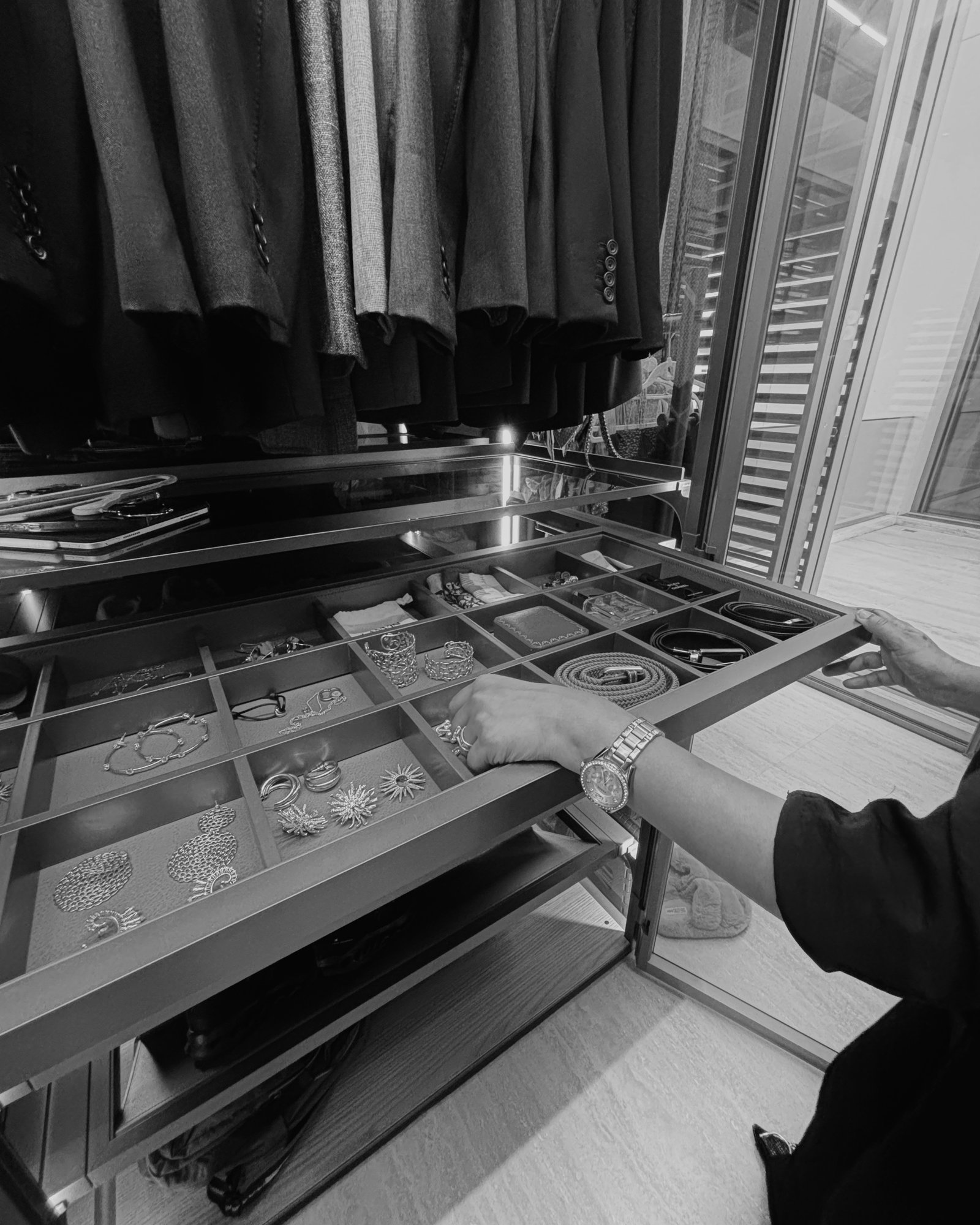
Every three months, our team returns for a full inspection - every cupboard opened, every significant piece examined, humidity discs replaced, small mends noted for the tailor, jewellery inspected for loose settings, shoes evaluated, bag hardware tested. Small repairs are commissioned before they become large ones. The client is never asked to remember when the last audit was; we hold that calendar for her. Every wardrobe we manage carries a written care protocol kept in the family home, not a manual for staff to execute independently, but a reference document that clarifies which pieces receive which treatment, which of our vetted vendors is engaged for which service. When household transitions happen, and they do, the wardrobe's continuity is untouched. Its institutional memory lives with us.
The household's actual role
None of this diminishes the household. The maid who presses a cotton kurta beautifully is doing what she was hired to do; we would not do it better. The driver who collects a package is our partner in the small logistics of a wardrobe that moves. But the pressing of an everyday kurta and the pressing of a chikankari with pearl detailing are not the same task. The dry-cleaning of a Manish Malhotra bridal is not a task to dispatch by driver at all. The line between domestic work and professional wardrobe work is the line we draw, clearly, the moment we take on a client. What sits above it is ours. A serious wardrobe, over a decade, accumulates a value comparable to the family's watch collection, contemporary art, or fine wine. It deserves the same recognition, that a category this significant belongs in professional custody. Discretion. Intention. Legacy.
Frequently Asked Questions
Can our household staff manage our wardrobe if we train them well?
No. This is not a question of training but of expertise, vendor access, and continuity. Domestic staff are excellent at domestic work; wardrobe management is a distinct profession a household role cannot absorb.
What does professional wardrobe management by The Luxe Wardrobe include?
End-to-end custody - seasonal rotation, quarterly inspection, jewellery review, shoe and bag restoration, tailor and atelier coordination, digital cataloguing, and vendor management, conducted on-site by our team.
How often does your team visit the home?
Quarterly at minimum for inspection, twice a year for the full seasonal rotation, and ad hoc for restoration commissions, new acquisitions, and pre-function styling preparation.
What happens when household staff transition?
The wardrobe's care is unaffected, because it lives with us. Written protocol, vendor relationships, and our visit calendar continue without interruption through any household change.
Do you also handle jewellery, shoes, and bag care?
Yes, through our specialist vendor network. Jewellery inspection with the family jeweller, shoe restoration through workshop partners, bag conditioning through our leather atelier. Every commission is supervised by us.
A private view into new launches, trusted brands, and what’s next.