


The Kaan Chain Returns; And So Does the Case for Curated Adornment
Festive dressing has entered its heritage renaissance. What that asks of the modern wardrobe.
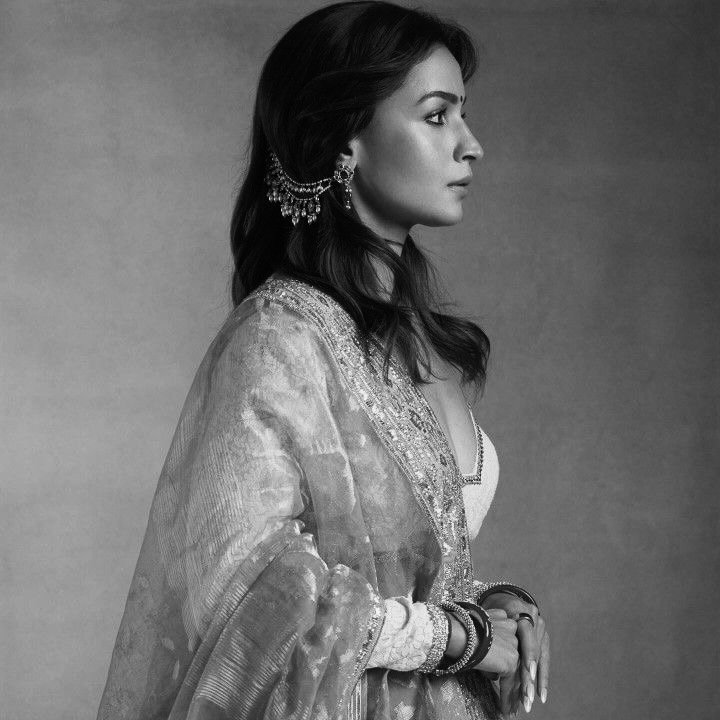
Somewhere between a Sonam Kapoor Abu Jani Sandeep Khosla frame and a Genelia Deshmukh paranda moment, a quiet decree was issued: the ear is now a stage. The kaan chain- that filigreed, pearl-strung, temple-scaled ornament our grandmothers wore to weddings and put away with camphor, has returned to festive attention. Vogue India has called it the season's jewellery MVP; we would call it something older. A homecoming.
The kaan chain is not new. Wound sinuously from the earlobe to a fastening at the hairline, or cascading in tiered strands of gold, kundan, or freshwater pearl, it belongs to a lineage that predates the styling grid; Awadhi courts, Marwari trousseaux, Rajput miniatures. What is new is its return to the front page of contemporary festive dressing, an unmistakable signal that the pendulum has swung from minimalism back toward maximal, considered heritage.
For the wardrobe, this is not a small adjustment.
A resurgent kaan chain is not an accessory decision; it is a silhouette decision. It rearranges the geometry of the neckline. It calls for a hairstyle that yields to it, a saree drape that clears it, a blouse whose embroidery does not compete with it. Worn beside a paranda, it asks the ensemble to make room. Worn with an Abu Jani lehenga in cloud-white chikankari, it becomes the ensemble. This is why heritage adornment has always demanded the stylist's discipline; it does not sit quietly on top of an outfit - it reorganises it.
Where Personal Shopping Enters
At The Luxe Wardrobe, we have watched the festive brief evolve over three seasons. The principal who once asked us to source a lehenga now asks us to source the entire portrait - textile, jewel, footwear, dupatta weight, the length of the ornament relative to the fall of her hair. Personal shopping in this register is not a transaction; it is a commission.
The kaan chain is instructive because it reveals how many quiet decisions sit behind a single festive appearance. Are we sourcing from a Jaipur atelier that still hand-strings temple-scaled kundan? A contemporary Mumbai house reinterpreting it in diamond and pearl? Or restoring a piece already resting in the family vault, waiting for a competent eye to restage it? Each answer produces a different bill, a different lead time, and a different final photograph. Our role is to know which conversation to open, and with whom, before the first sample is requested.
Where Personal Styling Enters
Sourcing is the easier half. The harder half is the pairing.
A kaan chain worn with the wrong neckline flattens the face; worn with the right one, it lengthens the throat and reframes the profile. Paired with a competing maang tikka, it becomes noise; worn alone, framed by a low chignon or a side-swept ponytail, it becomes narrative. This is the editorial discipline personal styling contributes - the confidence to remove three pieces so that one may be seen.
Our stylists work across the full silhouette: how the choker sits against the fastener, whether the blouse sleeve should be sheer or embroidered, whether the drape needs to be moved off the shoulder entirely so the ornament reads clean from the third row of a mandap.
For our clients dressing across a wedding season - sangeet in Udaipur, cocktail in Delhi, reception in London - this coordination extends into logistics. A single heritage piece may travel to four cities, be paired with three different colour families, and photographed under lighting no stylist has previewed. It must be documented, catalogued, insured, and packed with the same seriousness as the couture around it. Our wardrobe management practice absorbs this discreetly, in the background, so the principal simply arrives and dresses.
The Larger Arc
The kaan chain's return is a symptom of something wider. Across client conversations we hear it repeatedly; a fatigue with disposable style, a renewed appetite for pieces with provenance, an interest in adornment that carries family memory rather than seasonal calendar. This is the register in which we prefer to work. Our four-movement method - Discover, Curate, Transform, Evolve - was designed for exactly this: to help a wardrobe move from what a client happens to own toward what a client would like to be photographed in for the next fifteen years.
A resurgent heritage ornament is a gift, in that sense. It offers the principal a reason to open the vault, revisit what was inherited, edit what has aged out of relevance, and commission what is missing. We are frequently asked to sit through that inventory beside her.
In Closing
The Vogue frame will pass, as all frames do. The kaan chain will remain - because heritage adornment always does, waiting for a season sophisticated enough to want it back. Our brief, when it arrives, is unglamorous in the best sense: to make sure the piece is right, the pairing is quiet, the archive is intact, and the woman wearing it is not thinking about any of the above.
Frequently Asked
Should I invest in a new kaan chain, or restore one from my family vault?
Where a family piece exists, we almost always recommend restoration first; provenance carries a weight no new commission can replicate. Where the vault is silent, we source from ateliers whose craftsmanship will hold its value across the next generation.
What is the right occasion for a kaan chain in a modern festive wardrobe?
Historically a bridal and pre-bridal ornament, it now reads beautifully at sangeets, cocktail evenings, and intimate mehendi ceremonies. We advise against pairing it with a receiving-line reception look, where a simpler ear can carry the room more effectively.
How does a personal stylist actually help with jewellery, versus a jeweller?
A jeweller sells the piece; a stylist places it. Our role is to test the kaan chain against face shape, neckline, hair discipline, and the other ornaments already on the body, and to remove whatever competes.
Can The Luxe Wardrobe source directly from ateliers?
Yes; our sourcing network spans heritage houses across Jaipur, Udaipur, Hyderabad, and Kolkata, alongside contemporary ateliers in Mumbai and Delhi. We manage the introduction, the commission, and the delivery, so the principal engages only where she wishes to.
How do you catalogue jewellery for a client who dresses across multiple cities?
Every piece in our clients' custody is photographed, dimensioned, insured, and paired with a suggested silhouette set. When a garment travels, its intended ornament travels with it - packed, documented, and re-catalogued on return.
A private view into new launches, trusted brands, and what’s next.